Fall into History: Delaware County's Grassroots Fight for Inclusive Voting
Voting has always mattered to the people of Delaware County. Before there was even a nation to vote for, Delco had already cast the deciding vote to create one. John Morton, a farmer and judge from Ridley Township, was the Pennsylvania delegate who broke the deadlock - voting yes on independence in 1776 over the fierce objections of his neighbors and friends. He died months later, reportedly shunned by many who had known him. His last recorded words: that history would prove him right. He wasn't wrong.
In Darby and Media. In Chester and Drexel Hill. In the farmhouses of Upper Darby and the parlors of Moylan. Long before modern voting rights coalitions, Delco residents were already doing the work: harboring freedom seekers, circulating petitions, speaking from pulpits, marching in the streets, and registering young people who had never held a ballot.
As we mark America's 250th anniversary, the story worth telling isn't just the one on the monuments. It's the one in the margins of history - carried by abolitionists who risked ruin, suffragists who refused to wait, and civil rights organizers who demanded that democracy live up to its promises. This is their story. And it's ours too.
Roots of Resistance: Thomas Garrett and Delco's Abolitionist Network
Thomas Garrett was born in 1789 on a farm in Upper Darby, the same Delco township where people today grab coffee and catch the Market-Frankford Line. The son of Quaker farmers, Garrett grew up with the conviction that all people were equal before God - a belief he would carry into one of the most consequential acts of civil disobedience in American history.
After relocating to Wilmington, Delaware, Garrett became one of the most active stationmasters on the entire Underground Railroad. Over the course of his life, he is credited with helping more than 2,700 freedom seekers find their way to safety, working alongside Harriet Tubman and the tireless Philadelphia-based conductor William Still. He was tried, convicted, and financially ruined for his beliefs - and refused to stop.
What fewer people know is that Garrett's network ran straight back to Delco. When freedom seekers reached Wilmington, many were passed along to Garrett's brother Edward, who maintained a safe house in Upper Darby. From there, they moved on to Philadelphia or found work and shelter in the county's free Black communities. The same Darby Friends Meetinghouse that sheltered this network also hosted legendary human rights and suffrage speakers - Lucretia Mott, Sarah Grimké, and Frances Ellen Watkins Harper among them. This wasn't a distant moral cause for Delaware County. It was happening on Garrett Road.
Today, the story of that network lives at the Underground Railroad Museum at Arlington Cemetery in Drexel Hill, located on the grounds of what was once the Garrett family's Riverview Farm. Housed in a replica of George Washington's Mount Vernon, the museum holds letters, artifacts, and historical records that document Garrett's work and the broader regional network. It's free and open to the public - and it's one of the most under-visited history sites in the entire county.
The abolitionist work that Garrett and his Delco neighbors carried out didn't end with the Civil War. It became the infrastructure for what came next: the fight to ensure that Black men could actually exercise the right to vote enshrined in the 15th Amendment - a promise that required its own defenders as poll taxes, literacy tests, and outright violence quickly followed.
Speaking Power: Dr. Anna Howard Shaw and the Suffrage Movement in Delco
A few miles from where Garrett's family farm once stood, in Moylan near Rose Valley, lived one of the most formidable voices in the history of American democracy. Dr. Anna Howard Shaw was a physician, a Methodist minister, and for more than a decade, the president of the National American Woman Suffrage Association (NAWSA). A thunderclap of a speaker, she could move an audience from laughter to tears to outrage in a single address. She chose Delco as her home.
Shaw led NAWSA from 1904 to 1915, during the movement's most contested years, traveling the country relentlessly and returning to Rose Valley whenever she could. She received the Distinguished Service Medal for leading the Woman's Committee of the Council of National Defense during World War I. She died in 1919, just a year before the 19th Amendment was ratified - the victory she had given her life to. A Pennsylvania Historical and Museum Commission marker honoring Shaw stands today at the intersection of South Orange Street and South Ridley Creek Road in Media, a few minutes from where she lived. It's easy to drive past without a second thought. It deserves a full stop. The next generation of vote advocates was already taking shape minutes away. Alice Paul, a Swarthmore College graduate (Class of 1905), carried Delco's Quaker reform tradition into the 20th century as the architect of the Silent Sentinels - the White House pickets that delivered the final push for the 19th Amendment - and later drafted the Equal Rights Amendment in 1923. Her papers and those of fellow activists are held at Swarthmore's Friends Historical Library, open to researchers and visitors today.
Local women's suffrage organizing in Delco preceded and outlasted Shaw's national leadership. Women in Chester, Media, and the surrounding townships formed local suffrage societies, circulated petitions, and pushed for state-level recognition years before ratification. Their names are less well known than Shaw and Paul's. Their work was no less essential.
Chester's Long Struggle: Civil Rights, the Ballot, and the Fight That Never Ended
Chester is one of the oldest cities in Pennsylvania - the place where William Penn and the colonial assembly adopted the Great Law of 1682, establishing the secret ballot, religious freedom, the right to trial by jury, and no taxation without representation. The city was writing democratic law before there was a nation to write it for.
It's also the city where the fight for those rights proved most persistent and most costly.
By the mid-20th century, Chester had become a focal point for civil rights organizing in Delaware County. The Chester NAACP, documented in the George Raymond Papers at Widener University, drove campaigns for integrated public schools, fair housing, and voter registration from the 1940s through the 1960s. The organizing happening in Chester wasn't peripheral to the national civil rights movement. It was part of the same fabric.
The proximity to Philadelphia mattered too. Octavius Catto - the Black educator and baseball pioneer killed on Election Day 1871 by a political operative trying to suppress Black voter turnout - is buried at Eden Cemetery in Collingdale. His murder stands as a brutal reminder that the 15th Amendment was a promise on paper, not a guarantee in practice. Making it real required generations of effort, in Chester, in Media, and across Delaware County.
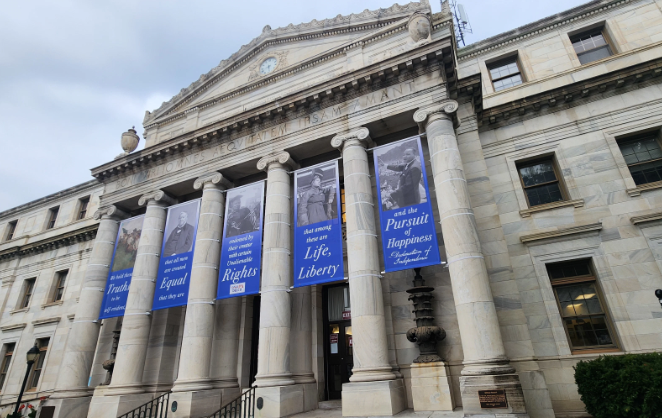
That history is woven into the Forging Freedom installation at the Delaware County Courthouse in Media, presented by America250PADelco and the Media Arts Council. The installation highlights five significant historical figures and moments from Delco that shaped the American democratic experiment. Standing at the courthouse steps where voting rights rallies have been held in recent years, looking up at Forging Freedom, it is impossible to miss the throughline: the right to vote has always been contested here, and it has always had defenders here.
The Work Continues: Ballot Access in a Modern County
Delaware County today is one of the most diverse and rapidly changing counties in Pennsylvania. Urban Chester, suburban Springfield, working-class Collingdale, and the college corridors of Villanova and Swarthmore sit within miles of each other. The barriers to voting have changed since Garrett's era, since Shaw's era - but they remain.
Modern advocacy in Delco reflects the same instinct that drove Quaker farmers to open their homes and suffragists to hold parlor meetings: the belief that every eligible voter should be able to cast a ballot without obstruction. Non-partisan organizations including the NAACP's Media and Chester branches, the Delaware County League of Women Voters, and PA Youth Vote have organized rallies at the courthouse, voter registration drives, and public education campaigns to ensure that diverse communities across the county know their rights and can access the polls.
Honoring the Legacy: The Delco Youth Voter Initiative
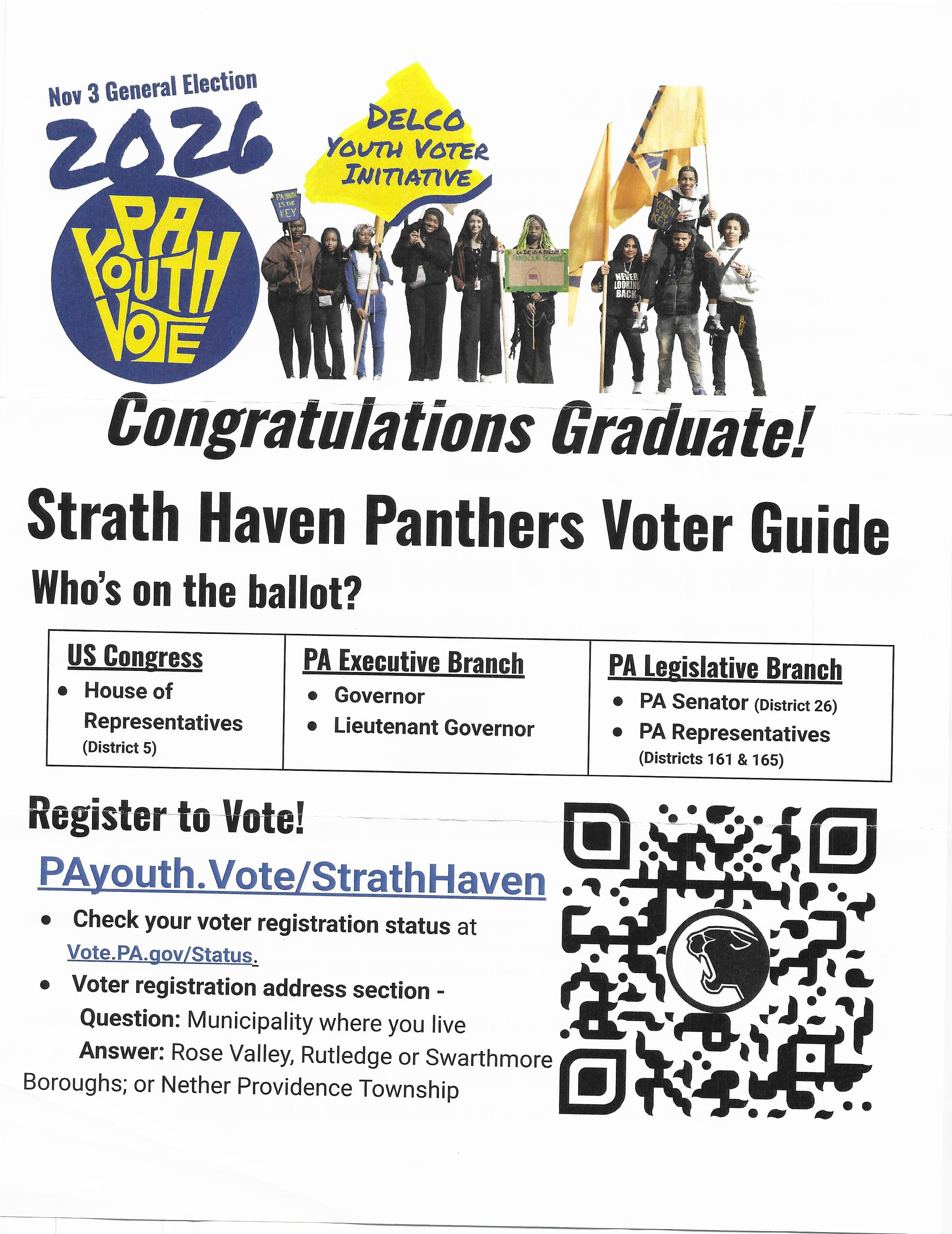
This year, America250PADelco joined the League of Women Voters of Delaware County to deliver certificates to Delco high school superintendents whose schools participated in the Delco Youth Voter Initiative - a nonpartisan effort that is, in its quiet way, one of the most direct descendants of everything described above.
The initiative is a coalition: the League of Women Voters of Delaware County, the Delaware County Bureau of Elections, PA Youth Vote, and the NAACP's Media and Chester branches. Together, they bring voter registration packets directly to high school seniors during graduation rehearsals, reaching more than 5,000 graduates with physical forms and digital election tools before they walk across the stage. The message is simple: you are of age. You have the right. Here is how to use it.
Garrett understood that rights without access are hollow. Shaw understood that the vote is voice. The Chester NAACP understood that democracy has to be built, and rebuilt, and defended in every generation. The students receiving those registration packets at graduation rehearsals are the inheritors of that work - some of them living on streets named for the organizers in this very post. Most of them don't know it. That's an invitation.
What You Can Do
The unsung champions of the ballot didn't ask to be remembered. They asked for results.Visit the Underground Railroad Museum at Arlington Cemetery and see the network that Garrett built. Walk past the Anna Howard Shaw marker in Media and read what it says. Explore guided history tours at Darby Friends Meetinghouse & Burial Ground. Stand in front of Forging Freedom at the Courthouse and trace the throughline.
And then vote on November 3. Bring someone with you to the polls who might otherwise not make it. Talk to a young person about what voting actually means, where it came from, and who fought to make it possible.
Delaware County's history of fighting for the ballot is extraordinary. The best way to honor it is to use one.